

A 4-Day Tokyo Itinerary | How an Efficiency-Minded Traveler Spends Their Trip
“Tokyo — how much can you really enjoy in just four days?” It’s a wall that travelers using a long weekend often run into. Shinjuku, Shibuya, Asakusa, Akihabara, Odaiba… list out everything you want to see, and you’ve easily got two weeks’ worth of plans. That’s the tricky part of a city like Tokyo — and also what makes it so fun.
The truth is, there’s a knack to covering Tokyo “efficiently” in four days. Divide your schedule by area, choose your transportation wisely, and build in “the kind of time you can’t easily get on a tour bus.” After five years in Japan, from showing friends from back home around, here’s what I can tell you: Tokyo is both a “walking city” and a “racing-through city,” and enjoying both faces of it completely changes how the trip sticks in your memory.
In this guide, I’ll share an efficient itinerary that’s perfect for a 4-day Tokyo long weekend, plus how to fit in a street kart experience that becomes the highlight of your stay.
Tips for Realistically Budgeting Your Time Over Four Days
The first thing I want to mention is a pitfall that’s easy to overlook in Tokyo sightseeing: estimating travel time. Even when Google Maps says “30 minutes,” once you factor in transfers, walking through stations, and crowds, it feels more like 45 minutes to an hour. You can’t just zip around by car like in the U.S.
That’s why I always recommend the same approach to friends from back home: narrow it down to “two areas per day.” For example, Asakusa in the morning and Akihabara in the afternoon — pair places that are geographically close. Just doing this cuts down wasted travel time dramatically. On paper, four days could let you cover up to eight areas, but realistically, keeping it to around six lets you actually savor each place.
And one more thing: Tokyo is packed during holidays. On a Saturday, the Shibuya Scramble Crossing reportedly sends a huge number of people across all at once with each green light. In other words, the more iconic the spot, the better it is to visit early in the morning or at night. Senso-ji Temple at 7 a.m. is unbelievably quiet, and it’s so easy to get photos.
Day 1: Arrival — Feel Japan’s “Tradition” in the Asakusa & Ueno Area
You’ll typically arrive at Tokyo Station or your hotel from Narita or Haneda around midday. Since you’ll be dealing with jet lag and fatigue, I recommend taking it easy and tackling the eastern part of the city this day.
Snap a commemorative photo in front of Asakusa’s Kaminarimon Gate, then stroll along Nakamise Street snacking on dango and ningyo-yaki. Pay your respects at Senso-ji Temple, and take photos with the Skytree in the background. That route takes about two hours. From there, it’s just two train stops to the Ueno Park, Ueno Zoo, and Ameyoko area. Ameyoko is a place where you can experience “Japanese market culture,” and my foreign friends always get excited there. Honestly, the first time I came, even I thought, “This is Tokyo?!”
In the evening, make your izakaya debut in Asakusa or Ueno. More and more places have English menus now, and “Excuse me, English menu please” usually gets the message across. Getting back to the hotel early and sleeping well on Day 1 will make or break your performance for the rest of the trip.
Day 2: Soak Up “Today’s Tokyo” in Shibuya, Harajuku & Omotesando
Day 2 takes you to the western area — you could call it the heart of Tokyo. Arrive in Shibuya at 9 a.m. and start with the Hachiko statue and the Scramble Crossing. The window seats on the second floor of the Starbucks in the Shibuya Tsutaya building are the classic spot for shooting the crossing from above.
From there it’s about a 20-minute walk to Takeshita Street. Harajuku’s crepes, pop culture, and colorful fashion make it that classic “so Instagrammable you can’t stop” area for foreign tourists. Head through to Omotesando and the atmosphere shifts completely into a more grown-up streetscape. Being able to move between “teen Tokyo” and “sophisticated Tokyo” within the same area is the real treat of this day.
In the afternoon, take a forest bath at Meiji Jingu. Even though it’s smack in the middle of the city center, once you step onto the approach path, all you can hear is birdsong. One cultural difference I find interesting: there’s an unspoken rule not to talk loudly at shrines. I was nervous at first, but once you get used to it, the silence itself becomes comforting.
In the evening, head back to Shibuya and take photos on the pavement reflecting the neon. Shibuya after the rain turns the whole city pink — it’s like another world.
Day 3: Shinjuku, Tokyo Tower, and Racing Through the City by Street Kart
Day 3 takes a completely different turn — make it a day to enjoy Tokyo’s “motion.” In the morning, stroll through Shinjuku Gyoen, then slurp some authentic ramen at a Shinjuku underground food court for lunch. Up to here, it’s pretty standard Tokyo sightseeing.
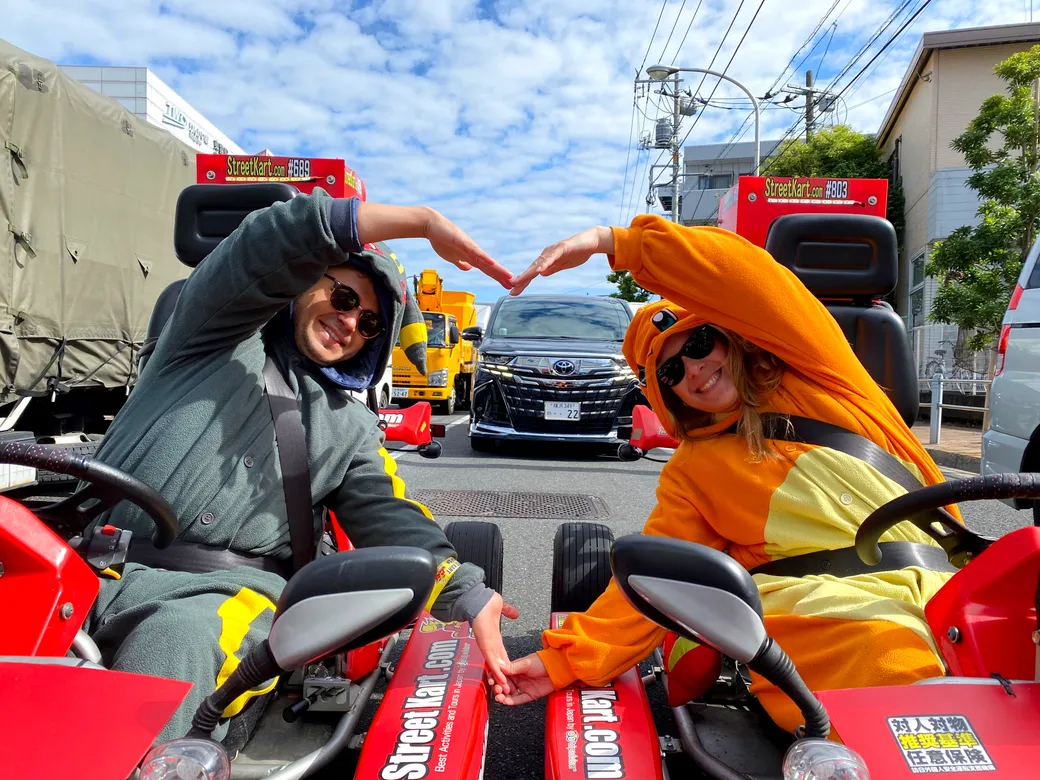
Here’s the key point. How do you make Day 3’s afternoon feel special? What I often recommend to friends from back home is a street kart experience with Street Kart, racing through the streets of Tokyo. As one of those “experiences you can only enjoy in Japan,” it’s the kind of thing that really sticks in your memory.
You hop into a kart and follow a guide along the tour route. The feeling of zipping past Tokyo Tower, the Rainbow Bridge, and the Odaiba area in a low-slung open kart is something you can’t easily get from a tour bus or taxi. Every time, my American friends are amazed: “You could never do this on public roads back home!” The engine sound, the wind, the neon lights, the smell of the city — it’s time spent soaking in Tokyo with all five senses.
Street Kart is a guided, tour-style activity where you enjoy Tokyo’s streetscape by kart. Since the tour follows a course led by a guide, it’s designed to be easy to join even for people unfamiliar with Tokyo’s roads. Each participant drives their own kart, but rather than driving freely like a rental car, you travel as a group along the route the guide leads you on.
You can make reservations through the official site at kart.st. Since bookings fill up quickly during holidays, it’s best to complete your online reservation before arriving in Japan. The driver’s license requirements are described in detail at kart.st, so checking in advance will put your mind at ease. Please confirm the details on the official site.
Features of Street Kart
As an option to take your Tokyo long weekend up a notch, Street Kart has several distinctive features.
First, its track record. According to the official site, the total number of tours conducted exceeds 150,000, the number of customers who have taken part so far is over 1.34 million, and the average rating is said to be 4.9/5.0★. With more than 20,000 reviews posted, it’s a service that has been used by travelers from all over the world.
Next, the guide system. Street Kart staffs guides trained for foreign drivers, and the service is provided in English. It’s easy to use even if you don’t speak Japanese, and since the website supports 22 languages, you can check information in something close to your native language right from the booking stage.
As for locations, there are 6 stores in Tokyo, plus Osaka and Okinawa, for a total of 8 stores. The total fleet is said to be over 250 vehicles, so it’s a setup where reservations are relatively easy to get even during peak holiday times. Having 6 stores in the Tokyo area alone also means it’s easy to choose a location close to your hotel.
And the tour format itself is a reassuring factor for first-timers. Since a guide leads the way, there’s little worry about getting lost even if you’re not familiar with Tokyo’s roads. The guide navigates the complex routes of the city center for you. It’s a system well suited to travelers who think, “I’d love to ride a kart through the streets of Tokyo, but I’m anxious because I don’t know my way around.”
Being easy to share on social media is another feature. The mounting position for an action camera, the scenery as you drive, the photo spots with Tokyo Tower in the background — there are plenty of moments that are easy to capture. After you return home, the reaction when you show your friends is different from other sightseeing experiences — that’s part of what makes Street Kart so interesting.
Day 4: Odaiba — Efficiently Using Your Final Few Hours Before Flying Home
On your last day, work backward from your flight time. You’ll have some breathing room in the morning, so do some shopping and photography in Odaiba. If you sit in the front car of the Yurikamome, the moment you cross the Rainbow Bridge is incredibly photogenic.
For lunch, have an authentic seafood bowl in the Tsukiji/Toyosu Market area. This instantly reinforces the memory of “the last meal I ate in Tokyo.” If you finish your souvenir shopping in the gift area inside Tokyo Station before boarding the train to the airport, you can wrap everything up efficiently.
A 4-day long weekend might seem short, but with proper planning, it’s enough time to experience a surprising amount. You can check detailed tour information on the official site at kart.st.
Making Your 4-Day Tokyo Trip an “Unforgettable Getaway”
When planning a 4-day Tokyo long weekend, what matters is balancing “the courage not to try to see everything” with “the boldness to build a special experience into a single day.” Of course you can’t skip the classics — Asakusa, Shibuya, Shinjuku — but if that’s all you do, the post-trip memory tends to end up as just “four days of walking around the city.”
Slot in an activity like a street kart experience that uses all five senses, and the overall impression of the trip changes. There’s a reason I always recommend it when friends from back home come to visit.
When it comes to holiday bookings, acting early is crucial. Weekends and public holidays can be full even two weeks out. If you’re going, an online reservation before arriving in Japan is the safe bet. Check availability at kart.st and lock in the backbone of your schedule on your very first day in Tokyo. Have you ever seen the streets of Tokyo from this perspective? A new discovery is waiting right here.
A Note About Costumes
Our shop does not rent out costumes related to Nintendo or “Mario Kart.” We only offer costumes that respect intellectual property rights.
